
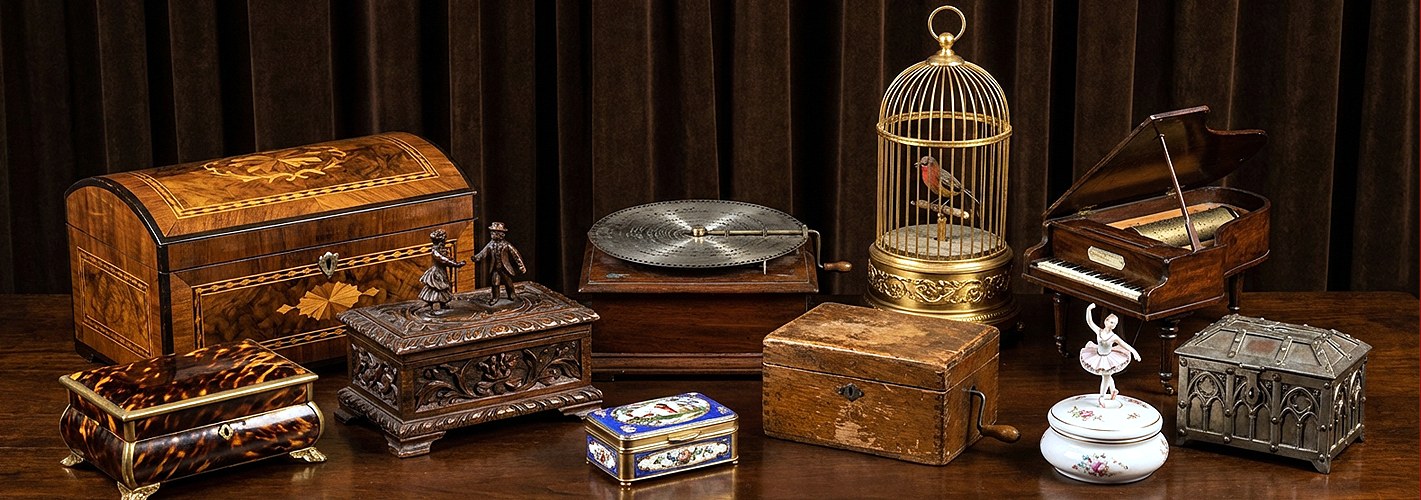
Early-century music boxes are precision musical instruments, engineered to create sound entirely through mechanical design. Crafted with finely cut gears, hand-tuned steel combs, and regulated springs, they represent an early mastery of music and engineering. Over time, wear is inevitable, and without proper care these instruments can fall silent.
The repair and restoration of early music boxes is an act of preservation, not modernization. It requires specialized knowledge, period-appropriate techniques, and musical sensitivity to maintain authenticity. The guide that follows explores the principles and practices essential to restoring early mechanical music and preserving its voice for generations to come.
- Introduction
- Preserving Mechanical Music as a Living Art Form
- The History of Mechanical Music Boxes
- How Music Boxes Work
- Common Problems Found in Antique Music Boxes
- Restoration Philosophy
- The Restoration Process
- Comb Repair & Tuning
- Repair vs. Full Restoration
- The Importance of Musical Expertise
- The Risks of Improper Restoration
- Long-Term Care After Restoration
- Preserving Mechanical Music for the Future
Introduction
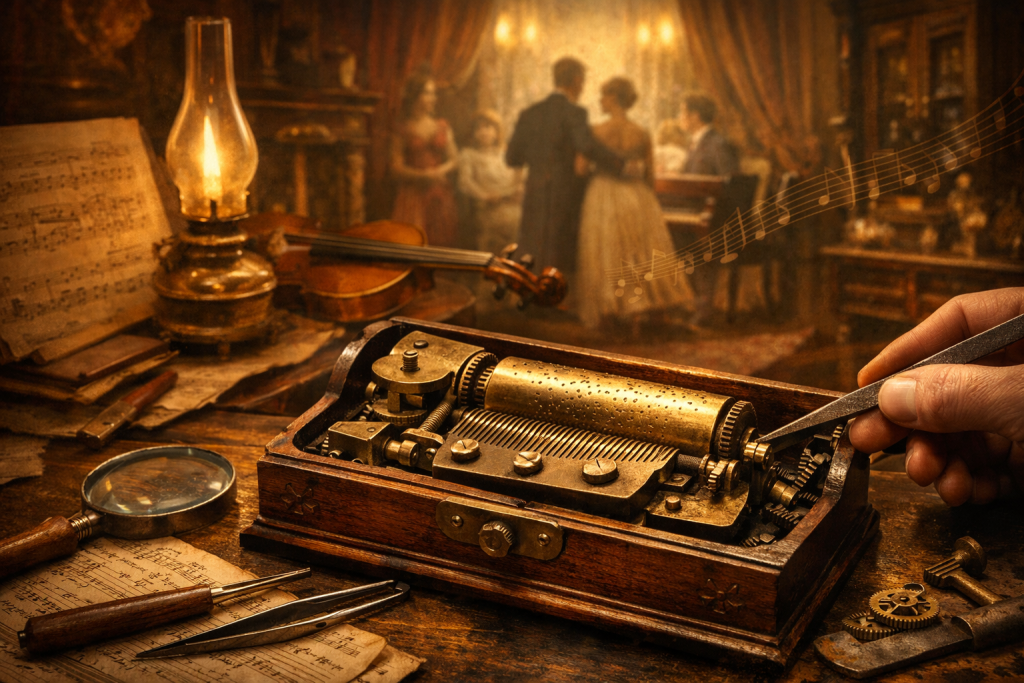
Before recorded sound, music lived inside machines. Through carefully shaped steel, finely cut gears, and ingenious mechanical design, music boxes transformed motion into melody, bringing music into homes, salons, and intimate gatherings. At a time when live performance was not always accessible, these instruments offered a remarkable alternative—capturing orchestral arrangements, popular airs, and sentimental tunes within compact mechanical forms. Each surviving music box stands as a testament to human ingenuity, reflecting a level of craftsmanship in which precision engineering and musical expression were inseparable. Built not only to function, but to endure, these instruments carried sound through time, embedding themselves in personal memory and cultural history alike.
The survival of mechanical music, however, is never guaranteed. Age, wear, environmental conditions, and improper handling slowly erode even the finest mechanisms. Springs weaken, gears wear, combs drift out of tune, and once-fluid motion becomes strained. Without knowledgeable care, these changes can silence an instrument permanently. Restoration, therefore, is not simply a matter of repair; it is an act of preservation that seeks to stabilize, protect, and honor the original work of the maker. Each decision made during restoration carries long-term consequences for the instrument’s sound, structure, and historical integrity.
This in-depth article serves as a guide to understanding the principles behind music box repair and restoration. It explores how mechanical expertise and musical sensitivity must work together to preserve authenticity, examining the delicate balance between intervention and restraint. True restoration respects original materials, sound, and design, favoring conservation over replacement and reversibility over convenience. The process demands patience, experience, and a deep understanding of both engineering and music—recognizing that every adjustment alters not just a mechanism, but a voice.
Preservation, in this context, is not about the past alone. It is about stewardship and continuity—ensuring that mechanical music remains a living tradition rather than a silent relic. When restored and cared for responsibly, music boxes continue to sing as they were intended, offering modern listeners a direct connection to another era through sound. To preserve a music box is to preserve an experience, a moment, and a craft that still has the power to resonate across generations, keeping mechanical music alive.
Preserving Mechanical Music as a Living Art Form
Antique music boxes are far more than decorative objects. They are precision-built musical instruments, historical artifacts, and works of mechanical art. Created long before recorded sound, they represent one of humanity’s earliest and most elegant methods of capturing music through engineering alone. The repair and restoration of these instruments is therefore not simply a mechanical task—it is an act of preservation that safeguards history, craftsmanship, and sound itself.
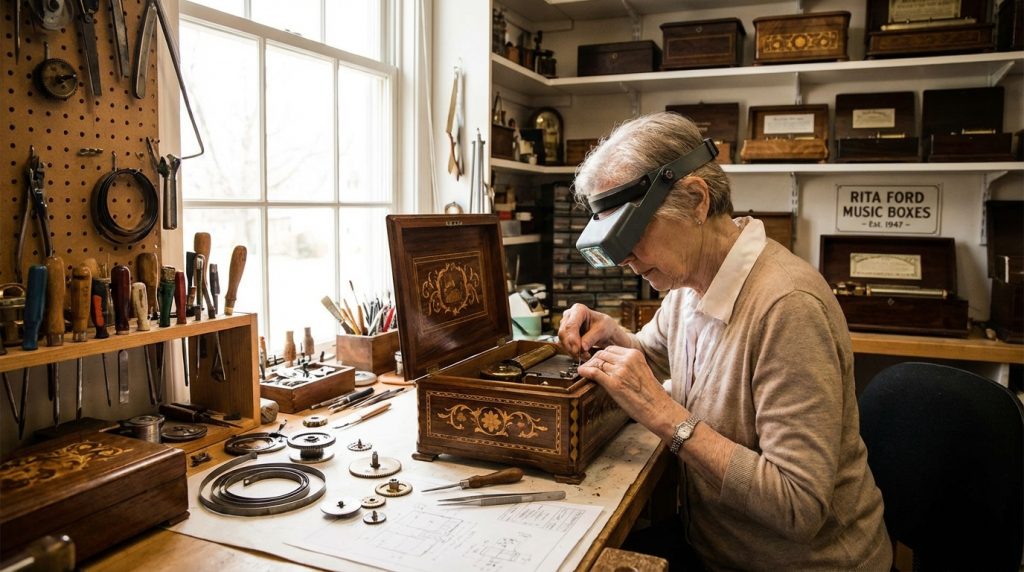
At Rita Ford Music Boxes, restoration is approached as stewardship. Every antique music box is treated as a unique artifact, deserving of careful evaluation, thoughtful conservation, and expert handling. Our primary focus is the repair, restoration, and sale of antique music boxes, with an emphasis on preserving originality, authenticity, and musical integrity.
Why Music Box Restoration Matters
Mechanical music is inherently fragile. Springs fatigue, gears wear, lubricants harden, and finely tuned steel combs drift out of pitch over time. Left untreated, these natural processes can lead to irreversible damage. Proper restoration halts deterioration, restores functionality, and allows the instrument to be played safely—often for decades to come.
Unlike modern electronic devices, antique music boxes cannot simply be replaced. Each one is a product of its era, reflecting the materials, technology, and musical tastes of its maker. Restoration ensures these instruments remain playable historical documents rather than silent curiosities.
Preservation, Not Modernization
True music box restoration is rooted in conservation, not modernization. The goal is never to make an instrument “better than new,” louder, or altered to contemporary taste. Instead, restoration seeks to return the music box to reliable operation while retaining its original sound, tempo, and mechanical character.
This philosophy includes:
- Preserving original components whenever possible
- Avoiding unnecessary replacement of parts
- Using period-appropriate materials and techniques
- Respecting original tuning, voicing, and timing
- Documenting all restoration work for historical continuity
A properly restored music box should sound as it did when it first left the maker’s workshop—not reinterpreted, but faithfully preserved.
Why Specialized Expertise Is Essential
Music box repair is among the most specialized forms of mechanical restoration. These instruments combine clockwork precision with musical sensitivity. Improper repair—often attempted by general clock, jewelry, or hobby repair services—can permanently damage a music box, reducing both its historical and monetary value.
Successful restoration requires:
- Deep mechanical knowledge of historical music box construction
- Specialized tools and techniques unique to mechanical music
- A trained musical ear for accurate tuning and voicing
- Experience with antique materials and aging mechanisms
At Rita Ford Music Boxes, this expertise has been developed over decades of focused work with antique mechanical music.
A Tradition of Stewardship
Since 1947, Rita Ford Music Boxes has been dedicated to preserving mechanical music through expert restoration, careful repair, and responsible sales of antique music boxes. Each instrument entrusted to us is approached with respect for its history and an understanding of its cultural significance.
Restoration is not simply about making music boxes play again—it is about ensuring they continue to speak, sing, and resonate for generations yet to come.
The History of Mechanical Music Boxes
From Early Innovation to Enduring Cultural Artifacts
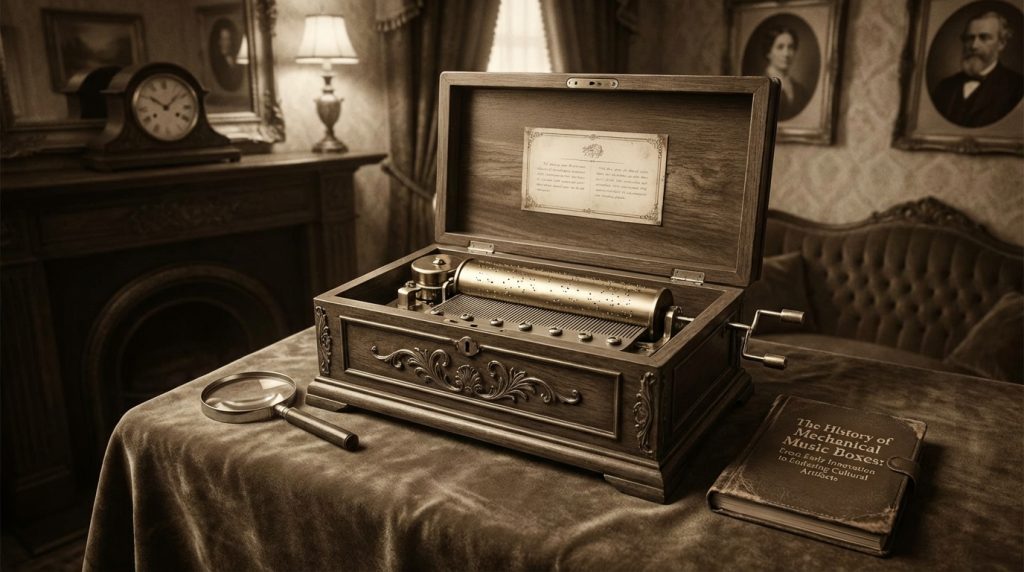
Mechanical music boxes trace their origins to the late 18th century, emerging from a period of rapid advancement in precision mechanics and musical instrument design. Early experiments in automated music grew out of clockmaking traditions, where artisans sought to translate timekeeping precision into controlled musical performance. These early devices laid the foundation for what would become one of the most remarkable forms of mechanical sound reproduction.
By the early 19th century, Switzerland—particularly the regions around Geneva and Sainte-Croix—became the global center for music box production. Swiss makers refined the pinned cylinder and steel comb system, achieving unprecedented musical clarity, volume, and reliability. Music boxes quickly evolved from novelty items into highly prized objects, admired for both their musical capability and mechanical sophistication.
Music Boxes Before Recorded Sound
Before the advent of phonographs and radio, music boxes played a vital role in domestic entertainment. They brought orchestral arrangements, popular melodies, and operatic themes into private homes at a time when live performance was not always accessible. For many families, a music box was the primary means of experiencing music on demand.
These instruments were also deeply personal. Music boxes marked milestones such as weddings, anniversaries, and commemorations. They served as luxury gifts, diplomatic offerings, and cherished heirlooms passed down through generations. Their music often became inseparable from memory—an emotional connection that remains powerful today.
The Golden Age of Mechanical Music
The mid-to-late 19th century is widely regarded as the golden age of music box production. During this period, makers expanded both the scale and complexity of their instruments. Large salon music boxes featured interchangeable cylinders, multiple combs, percussion effects, bells, drums, and even pipe organ-style mechanisms.
Advances in metallurgy allowed for stronger, more precisely tuned steel combs, while improvements in gearing produced smoother, more consistent performance. Decorative wooden cases—often crafted from walnut, rosewood, or burl—were designed not only to protect the mechanism but to enhance acoustics and visual appeal.
Music boxes became symbols of refinement, technological mastery, and artistic taste.
Discs, Automata, and Innovation
By the late 19th century, disc-operated music boxes emerged, offering louder sound, easier tune changes, and mass production advantages. At the same time, automata—mechanical figures synchronized to music—captured public imagination. Singing birds, moving dancers, and animated scenes elevated music boxes from instruments to theatrical experiences.
These innovations demonstrated the extraordinary creativity of mechanical music makers, pushing the limits of what could be achieved without electricity.
Decline and Survival
The early 20th century brought significant change. The rise of phonographs, radios, and later electronic recording technologies led to a rapid decline in music box production. Many workshops closed, and countless instruments were discarded, neglected, or dismantled.
Yet a dedicated group of collectors, restorers, and enthusiasts ensured the survival of mechanical music. Music boxes transitioned from everyday entertainment to historical artifacts, valued for their craftsmanship, sound, and cultural importance.
Music Boxes Today
Today, antique music boxes are appreciated as rare examples of pre-electronic sound reproduction. Museums, collectors, and institutions recognize their significance not only as musical instruments, but as objects that embody the ingenuity and artistry of their time.
Their continued survival depends on careful preservation, knowledgeable restoration, and responsible stewardship—ensuring that these instruments remain playable, audible, and meaningful rather than silent relics.
How Music Boxes Work
Anatomy, Mechanics, and the Precision Behind the Music
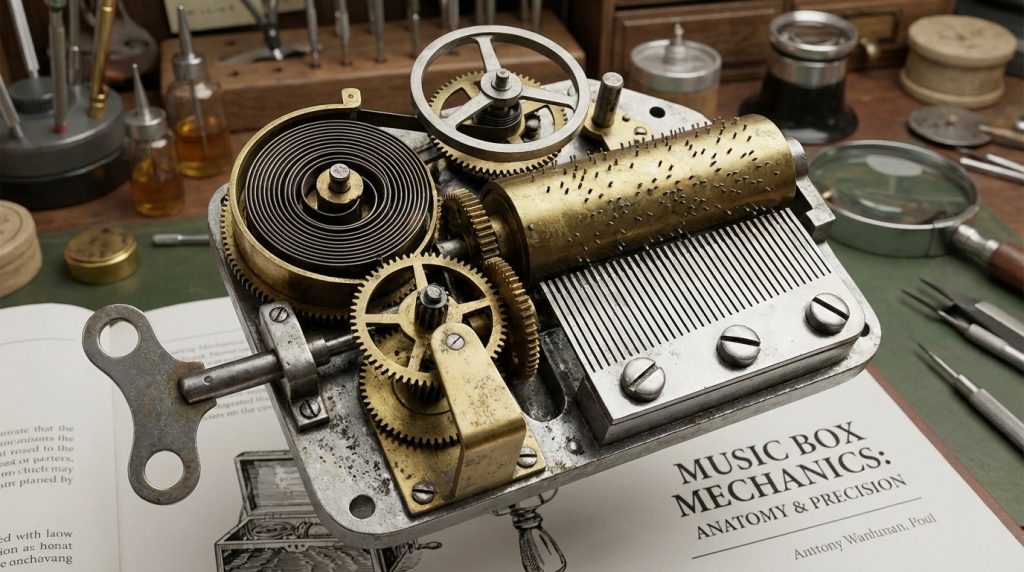
At first glance, an antique music box may appear simple—turn a key, release a lever, and music begins to play. In reality, these instruments are highly sophisticated machines in which every component must work in perfect harmony. Understanding how a music box functions reveals why expert repair and restoration are essential, and why even minor wear or misalignment can dramatically affect performance.
A mechanical music box is, at its core, a controlled system for converting stored mechanical energy into sound. This process relies on precision engineering, careful timing, and finely tuned components working together as a unified whole.
The Power System: Mainspring and Regulation
The heart of the music box is its mainspring, a tightly coiled steel spring that stores energy when the instrument is wound. As the spring unwinds, it releases power gradually through the gear train. The quality, strength, and condition of the mainspring directly influence tempo, volume, and consistency.
To regulate this power, music boxes employ governors or flywheels, which control the speed of the mechanism. Proper regulation ensures the music plays at the intended tempo—neither rushed nor sluggish. Worn springs or damaged governors can cause uneven pacing, abrupt stops, or excessive strain on internal components.
The Drive Train: Gears, Arbors, and Precision Motion
The drive train transfers energy from the mainspring to the musical components. This system consists of gears, pinions, arbors, and pivots that must mesh smoothly and rotate with minimal resistance. Over time, wear at pivot points and gear teeth can introduce friction, noise, and instability.
Even slight deviations in alignment can affect timing, causing missed notes, repeated tones, or mechanical binding. Because these parts were often hand-finished by original makers, restoration requires careful correction rather than replacement to preserve authenticity.
Cylinders and Discs: Programming the Music
Music boxes are programmed mechanically through either pinned cylinders or perforated metal discs.
- Cylinder music boxes use carefully placed pins to pluck specific teeth on the comb, determining melody, rhythm, and harmony. Some cylinders are interchangeable, allowing multiple tunes.
- Disc music boxes rely on stamped or perforated steel discs that engage levers or fingers to activate the comb.
In both systems, precise alignment is critical. Worn pins, warped discs, or improper spacing can alter musical phrasing and damage the comb.
The Comb: The Voice of the Music Box
The steel comb is the soul of the instrument. Each tooth is tuned to a specific pitch, forming the musical scale. The thickness, length, and metallurgy of each tooth determine its tone and resonance.
Comb damage—such as bent, cracked, or broken teeth—is one of the most serious issues in music box restoration. Tuning a comb requires extraordinary care, as removing even microscopic amounts of metal permanently alters pitch. For this reason, comb work is considered one of the most specialized aspects of restoration.
Control Mechanisms and Musical Expression
Music boxes often include start and stop levers, repeat functions, tune selectors, and tempo controls. These features allow for user interaction while protecting the mechanism from abrupt engagement or disengagement.
In complex instruments, multiple musical elements—such as bells, drums, or automata—must be synchronized precisely. When properly adjusted, these components create a rich, expressive performance that feels surprisingly organic despite being entirely mechanical.
The Case: Structure, Acoustics, and Protection
The wooden case is not merely decorative. It serves as a structural foundation and acoustic chamber, influencing sound projection and tonal warmth. Cases were often crafted from fine woods such as walnut, rosewood, or mahogany, with joinery designed to support the mechanism securely.
Environmental changes can cause wood to expand or contract, affecting alignment and acoustics. Restoration must address both mechanical and structural integrity to ensure long-term stability.
Why Understanding Matters
Every music box is a delicate balance of force, timing, and sound. Because these instruments rely on mechanical precision rather than electronic correction, there is no margin for error. Proper repair and restoration depend on a deep understanding of how each component interacts with the others.
This complexity is why music box restoration remains a specialized discipline—one that combines engineering, musical knowledge, and historical sensitivity.
Common Problems Found in Antique Music Boxes
How Time, Wear, and Improper Repairs Affect Mechanical Music
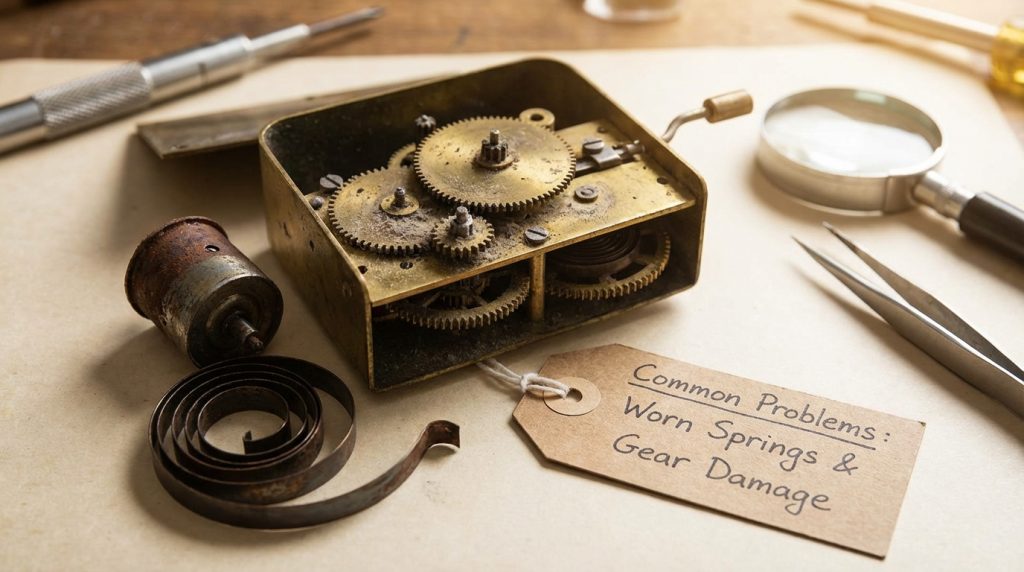
Antique music boxes are remarkable survivors, often continuing to play decades—or even centuries—after their creation. However, time inevitably takes its toll. Mechanical wear, environmental exposure, and earlier repair attempts can compromise both performance and preservation. Understanding the most common problems found in antique music boxes helps owners recognize when professional attention is needed and why timely restoration is essential.
Many issues develop gradually and may not be immediately obvious. What begins as a subtle change in tempo or tone can quickly progress into serious mechanical damage if left unaddressed.
Worn Mainsprings and Power Irregularities
One of the most common problems in antique music boxes is mainspring fatigue. Over time, springs lose strength, develop cracks, or break entirely. A weakened spring produces uneven power, causing fluctuations in tempo, sudden stops, or excessive strain on gears and the governor.
Improper replacement springs—often installed during past repairs—can be equally damaging. Springs that are too strong or incorrectly sized can accelerate wear and permanently distort original components.
Gear Wear and Pivot Damage
The constant movement of gears and arbors leads to wear at pivot points, particularly in instruments that have not been serviced regularly. Worn pivots can cause wobble, friction, and misalignment within the drive train.
As wear progresses, gears may no longer mesh properly, resulting in mechanical noise, skipped notes, or binding. Left untreated, pivot wear can lead to cracked plates or irreparable damage to original gearwork.
Comb Damage and Tuning Drift
The steel comb is among the most vulnerable components of a music box. Common issues include:
- Bent or cracked teeth
- Broken teeth caused by impact or misalignment
- Corrosion affecting tonal quality
- Gradual tuning drift over time
Comb damage not only affects sound but also increases the risk of further breakage if the music box continues to play improperly. Because combs are often original to the instrument and difficult—or impossible—to replace, expert repair is critical.
Cylinder and Disc Wear
In cylinder music boxes, worn or damaged pins can result in missed notes, double striking, or uneven musical phrasing. Cylinders may also become misaligned due to case movement or mechanical stress.
Disc music boxes face similar challenges. Warped discs, worn engagement fingers, or incorrect disc pressure can alter performance and cause damage to both disc and comb.
Hardened Lubricants and Contamination
Original lubricants used in antique music boxes often harden over time, becoming sticky rather than protective. This increases friction and accelerates wear throughout the mechanism. Dust, debris, and environmental contaminants compound the problem, particularly in instruments stored without proper protection.
Improper cleaning attempts—especially the use of modern solvents—can strip finishes, damage metal surfaces, and remove original patina.
Case and Structural Issues
Wooden cases are sensitive to changes in humidity and temperature. Over time, wood may shrink, warp, or crack, affecting both appearance and mechanical alignment. Loose mounting points can cause the mechanism to shift, leading to comb misalignment or cylinder contact issues.
Structural instability often manifests as new mechanical problems that appear unrelated but are rooted in case movement.
Damage from Improper Past Repairs
Many antique music boxes suffer from well-intentioned but harmful past repairs. Common mistakes include:
- Over-lubrication
- Aggressive polishing of original parts
- Incorrect replacement springs
- Non-original screws or fasteners
- Modern adhesives that cannot be reversed
These interventions can permanently alter the instrument and complicate future restoration efforts.
When to Seek Professional Restoration
Any of the following signs indicate the need for expert evaluation:
- Uneven or erratic tempo
- Harsh, distorted, or muted sound
- Mechanical noise or resistance
- Missing or repeated notes
- Visible corrosion or damage
- Evidence of past improper repair
Early intervention often prevents more extensive—and costly—restoration.
Restoration Philosophy
Conservation Over Replacement
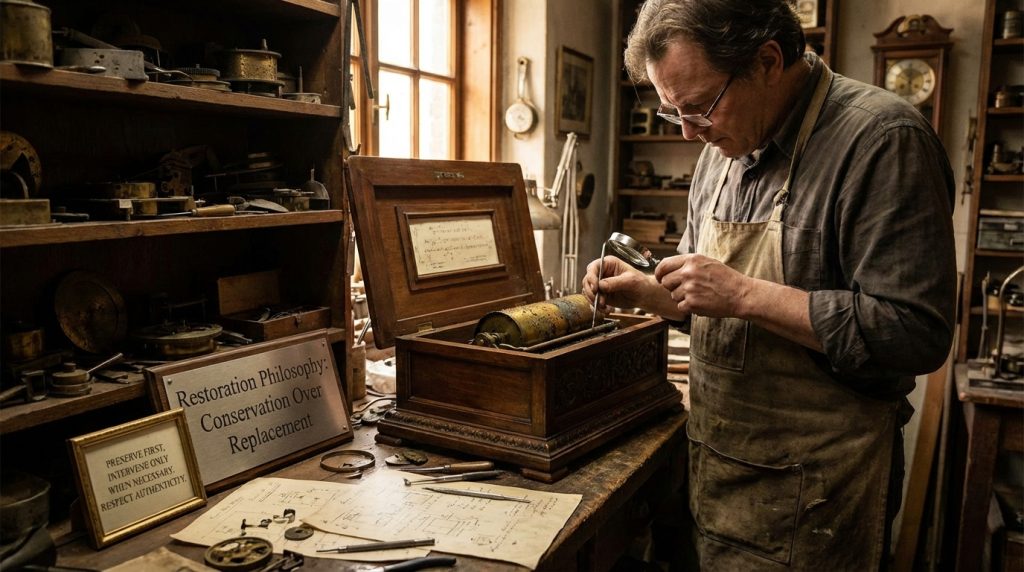
At the heart of professional music box restoration lies a guiding principle: preserve first, intervene only when necessary. Antique music boxes are irreplaceable historical artifacts, and every original component—no matter how worn—carries information about the instrument’s maker, period, and intended sound. Restoration, therefore, is not about modernization or cosmetic perfection, but about thoughtful conservation that respects authenticity.
This philosophy distinguishes true restoration from routine repair. Where repair may focus on immediate function, conservation-centered restoration considers the long-term survival of the instrument and its historical integrity.
Preserving Original Materials
Original components are always preferred over replacement. Gears, combs, springs, screws, and even wear patterns tell a story that cannot be recreated once removed. Whenever possible, original parts are stabilized, repaired, and retained rather than replaced.
Replacement is considered only when:
- A component is structurally unsound
- Continued use would risk further damage
- No repair method can restore safe operation
When replacement is unavoidable, new parts are fabricated to match original specifications as closely as possible and documented accordingly.
Minimal and Reversible Intervention
Ethical restoration emphasizes minimal intervention. Every adjustment is evaluated for necessity, and alterations are kept as limited as possible. Wherever feasible, restoration methods are chosen so they can be reversed by future caretakers without damaging original material.
This approach ensures that future advances in conservation techniques can be applied and that the instrument remains adaptable to responsible care over time.
Respecting Original Sound and Musical Intent
Sound is one of the most critical aspects of authenticity. Music boxes were designed with specific tempos, dynamic ranges, and tonal balances. Altering these elements—even unintentionally—can distort the maker’s intent.
Conservation-minded restoration seeks to:
- Maintain original tuning and voicing
- Preserve natural tonal warmth and resonance
- Avoid excessive volume or altered tempo
- Retain characteristic phrasing and articulation
The goal is fidelity, not enhancement.
Period-Appropriate Techniques and Materials
Music boxes were built using materials and methods specific to their era. Restoration honors this by employing techniques and materials that align with original construction whenever possible. Modern substitutes are used cautiously and only when they provide stability without compromising authenticity.
This historically informed approach protects both mechanical integrity and historical value.
Documentation and Transparency
Every restoration is thoroughly documented. Records may include photographs, measurements, tuning notes, and descriptions of work performed. This documentation becomes part of the instrument’s history, supporting future care and scholarly research.
Transparency builds trust with collectors, museums, and institutions, ensuring clarity about what has been preserved, repaired, or replaced.
Stewardship, Not Ownership
Restoration philosophy ultimately reflects a broader responsibility. Those who care for antique music boxes are not merely owners—they are stewards. Each decision made during restoration affects how the instrument will survive, sound, and be understood by future generations.
By prioritizing conservation over replacement, restoration becomes an act of respect—honoring both the craftsmanship of the past and the cultural legacy these instruments represent.
The Restoration Process
A Step-by-Step Approach to Preserving Mechanical Music
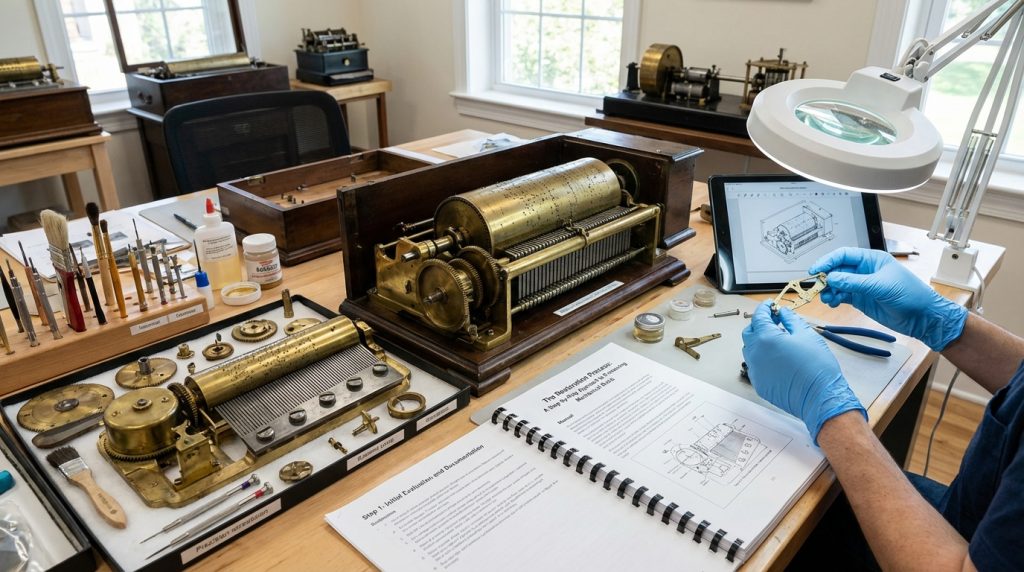
The restoration of an antique music box is a deliberate and highly methodical process. Each stage is performed with care, patience, and respect for the instrument’s historical and musical integrity. No two music boxes are restored in exactly the same way; every piece presents its own challenges, wear patterns, and preservation needs. However, professional restoration generally follows a structured sequence designed to ensure accuracy, stability, and long-term reliability.
Step 1: Initial Evaluation and Documentation
Restoration begins with a thorough examination of the music box in its current state. The restorer listens carefully to the instrument, noting tempo irregularities, tonal inconsistencies, mechanical noise, and resistance. Visual inspection identifies wear, corrosion, previous repairs, and structural concerns.
Historical research may also be undertaken to determine the maker, approximate date, and original configuration. Photographs, measurements, and written notes are recorded before any work begins, establishing a clear reference point and preserving the instrument’s pre-restoration condition.
Step 2: Careful Disassembly
Disassembly is performed slowly and methodically to avoid stressing fragile components. Each screw, spring, washer, and gear is removed in a controlled sequence, labeled, and organized. Original finishes, patina, and surface treatments are preserved.
Improper disassembly is one of the most common causes of damage in antique music boxes. Professional restoration avoids forcing components and respects the tolerances established by the original maker.
Step 3: Cleaning and Stabilization
Over time, old lubricants harden, dust accumulates, and corrosion forms. Cleaning removes these contaminants while preserving original material. Different metals and finishes require specific cleaning methods, often combining mechanical and chemical techniques tailored to the component.
Cleaning is conservative by design. The goal is stabilization, not cosmetic perfection. Original patina is retained whenever possible, as it contributes to both authenticity and historical value.
Step 4: Mechanical Repair and Rehabilitation
Once clean, components are evaluated for wear and damage. Worn pivots may be polished or rebushed, gears realigned, and arbors corrected to restore smooth motion. Mainsprings are serviced, repaired, or—when necessary—custom fabricated to match original specifications.
Cylinders and discs are corrected for timing and alignment to ensure proper engagement with the comb. All mechanical repairs prioritize retaining original parts whenever feasible.
Step 5: Comb Repair and Musical Tuning
Comb repair and tuning represent the most specialized phase of restoration. Bent or cracked teeth are carefully corrected or repaired. Replacement is considered only when a tooth is beyond repair.
Tuning is performed by hand, removing microscopic amounts of metal to achieve precise pitch. This process requires musical training, patience, and experience, as each adjustment permanently alters the comb. The goal is to preserve the original tonal character and balance of the instrument.
Step 6: Reassembly and Lubrication
After repairs are completed, the mechanism is reassembled with precision. Lubrication is applied sparingly using carefully selected modern equivalents of historic oils. Proper lubrication reduces friction while avoiding the risks associated with over-oiling.
Reassembly restores the instrument’s structural and mechanical integrity, preparing it for final regulation and testing.
Step 7: Regulation, Testing, and Final Adjustment
The fully assembled music box undergoes extensive testing. Tempo is regulated to original specifications, start and stop functions are adjusted, and musical performance is evaluated for consistency and expression.
Multiple play tests confirm smooth operation, reliable engagement, and faithful musical reproduction. Only when the instrument performs reliably and safely is restoration considered complete.
Restoration as a Process, Not a Shortcut
True restoration cannot be rushed. Each step builds upon the last, and shortcuts compromise both longevity and authenticity. A properly restored music box is not only functional—it is stable, expressive, and historically faithful.
Comb Repair & Tuning
Preserving the Voice of the Music Box
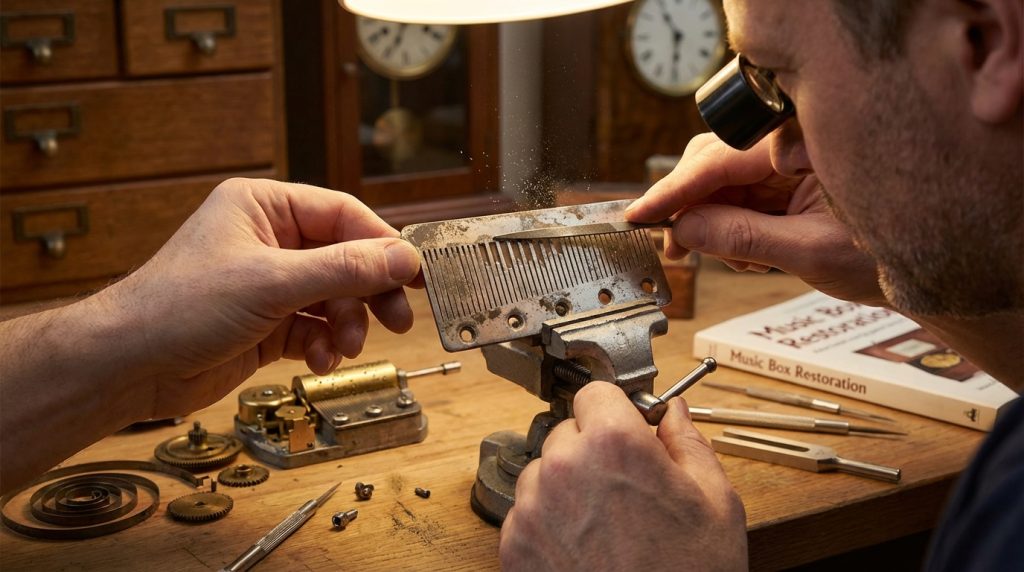
The steel comb is the heart and voice of a music box. While gears, springs, and cylinders provide motion, it is the comb that transforms mechanical energy into music. Each tooth is precisely shaped, tuned, and tempered to produce a specific pitch, and together they create the instrument’s distinctive tonal character. Because of this, comb repair and tuning are among the most delicate and critical tasks in music box restoration.
Damage or improper adjustment to a comb can permanently alter an instrument’s sound and value. For this reason, comb work requires exceptional skill, musical sensitivity, and experience.
Understanding the Music Box Comb
A music box comb consists of a solid steel base with individual teeth cut to specific lengths and thicknesses. Each tooth vibrates when plucked by a cylinder pin or disc finger, producing a musical note. The tone, sustain, and volume of each note depend on the tooth’s precise dimensions and metallurgy.
Even slight variations—often invisible to the eye—can affect pitch and timbre. This precision is why combs were among the most carefully crafted components of early music boxes.
Common Comb Issues
Over time, combs are vulnerable to several forms of damage:
- Bent teeth, often caused by misaligned cylinders or discs
- Cracked teeth, resulting from metal fatigue or impact
- Broken teeth, frequently due to improper past repairs
- Corrosion, affecting tone and sustain
- Tuning drift, as metal ages and environmental conditions change
These issues not only affect sound quality but can lead to further damage if the music box continues to play improperly.
Original combs are irreplaceable whenever possible. Replacement combs rarely match the original metallurgy, voicing, or tonal balance of antique instruments. For this reason, professional restoration prioritizes repair over replacement.
Repair techniques may include:
- Straightening bent teeth
- Stabilizing hairline cracks
- Reprofiling damaged tooth tips
- Reinforcing weakened areas
Replacement is considered only when a tooth is structurally unsalvageable and continued use would risk damage to adjacent teeth or the mechanism.
The Art of Tuning
Tuning a music box comb is an irreversible process. Pitch is adjusted by removing microscopic amounts of metal from specific areas of a tooth. Removing material from the tip lowers pitch; removing material closer to the base raises pitch. Each adjustment must be executed with extreme precision.
Tuning is performed:
- By hand
- By ear
- One tooth at a time
This process demands not only technical skill but a trained musical ear capable of recognizing subtle pitch variations and harmonic relationships.
Preserving Original Tonal Character
Antique music boxes were voiced to reflect the musical aesthetics of their time. Restoration tuning seeks to preserve:
- Original pitch standards
- Natural tonal warmth
- Balance between melody and accompaniment
- Authentic sustain and decay
Modernizing or “brightening” the sound compromises historical integrity and is avoided.
Risks of Improper Comb Work
Improper tuning or aggressive comb repair can permanently destroy a music box’s voice. Common mistakes include:
- Over-filing
- Inconsistent tooth shaping
- Incorrect pitch reference
- Attempting tuning without musical training
Once metal is removed, it cannot be replaced. For this reason, comb work should only be performed by experienced specialists.
The Musical Responsibility of Restoration
Comb repair and tuning represent the point where mechanics and music converge. It is here that restoration transcends technical work and becomes musical interpretation. The restorer’s responsibility is not to impose a new sound, but to faithfully preserve the instrument’s original voice.
A properly restored comb allows a music box to sing as it did when first created—clear, expressive, and unmistakably authentic.
Repair vs. Full Restoration
Understanding the Difference and Choosing the Right Approach
When an antique music box begins to malfunction, owners are often faced with an important decision: should the instrument receive a simple repair, or does it require a full restoration? While these terms are sometimes used interchangeably, they represent very different approaches, each with its own purpose, scope, and long-term implications.
Understanding the distinction is essential to preserving both the musical integrity and historical value of an antique music box.
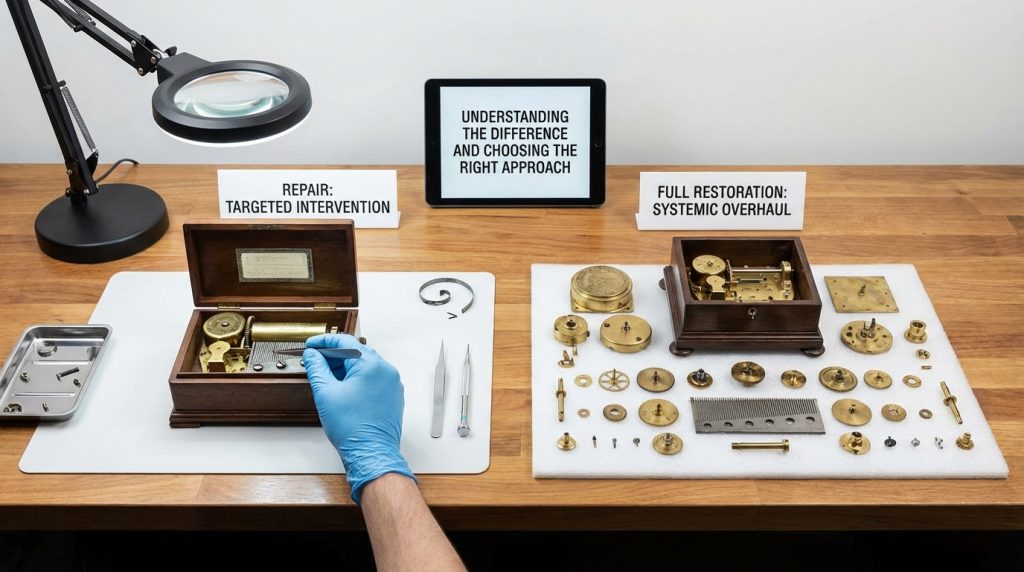
What Constitutes a Repair
A repair addresses a specific, identifiable problem that prevents the music box from functioning correctly. Examples include replacing a broken spring, freeing a seized gear, or correcting a misaligned start-stop mechanism.
Repairs are typically appropriate when:
- The mechanism is otherwise in stable condition
- Wear is localized rather than systemic
- The music box has been regularly maintained
- The instrument is not historically rare or fragile
In these cases, targeted intervention may safely return the music box to working order.
Limitations of Repair Alone
While repairs can resolve immediate issues, they often do not address underlying wear. An instrument may play again, but hidden problems—such as worn pivots, hardened lubricants, or early-stage comb fatigue—can continue to deteriorate.
Over time, this can lead to:
- Accelerated wear on original parts
- Recurrent mechanical failure
- Increased risk of irreversible damage
For antique instruments, repeated partial repairs may ultimately cause more harm than a single comprehensive restoration.
What Defines Full Restoration
A full restoration takes a holistic view of the music box as an integrated system. Rather than addressing one failure point, restoration evaluates and stabilizes all components—mechanical, musical, and structural.
Full restoration typically includes:
- Complete disassembly and cleaning
- Correction of wear throughout the drive train
- Mainspring servicing or replacement to original specification
- Cylinder or disc alignment
- Comb repair and tuning
- Structural case stabilization
- Extensive testing and regulation
The objective is not merely to make the instrument play, but to ensure safe, reliable, and historically faithful performance for years to come.
When Full Restoration Is Recommended
Full restoration is generally advised when:
- The music box is rare, valuable, or historically significant
- Multiple components show signs of wear
- Previous repairs have been poorly executed
- The instrument has not been serviced in decades
- Long-term preservation is a priority
For collectors, museums, and institutions, full restoration is often the most responsible course of action.
Cost vs. Value Considerations
While full restoration represents a greater initial investment, it often preserves value more effectively than repeated repairs. A properly restored music box is mechanically stable, musically accurate, and supported by documentation—attributes that enhance both historical and market value.
In contrast, instruments subjected to improper or piecemeal repairs may suffer diminished performance and reduced collectibility.
Making an Informed Decision
Choosing between repair and restoration requires expert evaluation. An experienced restorer can assess the instrument’s condition, historical importance, and intended use to recommend the appropriate approach.
The right choice balances functionality, preservation, and respect for the instrument’s past.
The Importance of Musical Expertise
Why a Trained Ear Matters in Music Box Restoration
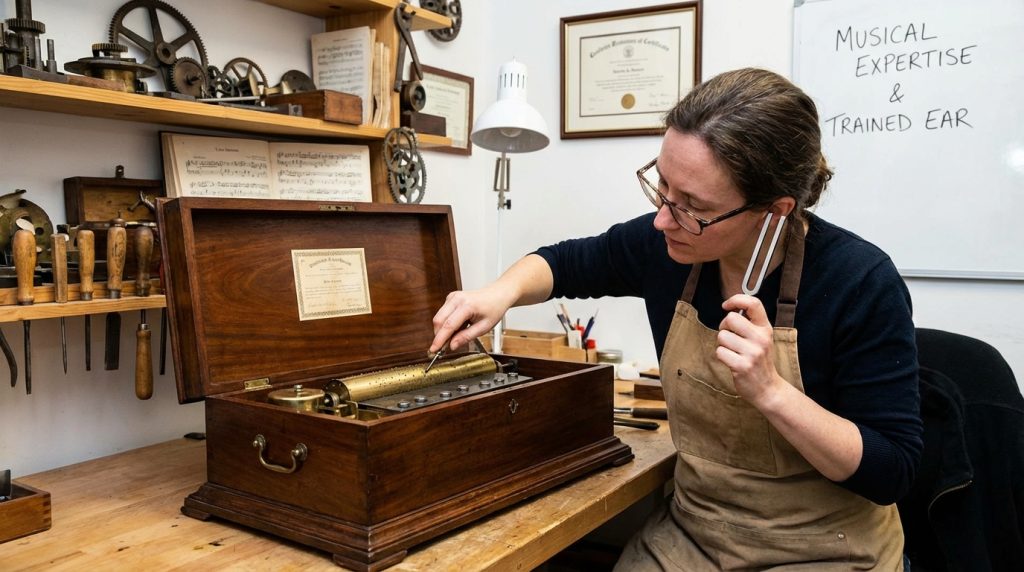
Music box restoration is often perceived as a purely mechanical discipline, but in reality, it is equally a musical one. While precision engineering ensures proper function, musical expertise ensures authenticity of sound. Without a trained ear and deep musical understanding, even the most mechanically sound restoration can fail to preserve what matters most—the music itself.
Antique music boxes were created by artisans who understood both mechanics and music. Restoring them requires the same dual mastery.
Mechanical Accuracy vs. Musical Authenticity
A music box may run smoothly yet still sound wrong. Tempo may feel rushed or sluggish, harmonies may be unbalanced, and melodies may lose their intended phrasing. These issues cannot be corrected with tools alone; they require musical judgment.
Musical expertise allows the restorer to:
- Recognize correct pitch and interval relationships
- Preserve rhythmic intent and tempo
- Balance melody against accompaniment
- Identify tonal color unique to each instrument
Without this insight, restoration risks becoming mechanical correction rather than musical preservation.
Tuning Is a Musical Decision
Comb tuning is the clearest example of where musical training is essential. Each adjustment permanently alters pitch, and even microscopic errors accumulate across the scale. A trained musician understands not only pitch accuracy, but harmonic context—how notes relate to one another within a piece.
Musical training enables:
- Accurate pitch referencing
- Sensitivity to tonal warmth and sustain
- Preservation of original voicing
- Avoidance of over-bright or modernized sound
These decisions shape the instrument’s voice and emotional character.
Understanding Historical Musical Context
Antique music boxes were tuned to pitch standards that often differ from modern conventions. Musical expertise helps restorers recognize and respect these historical norms rather than forcing instruments into contemporary tuning systems.
A musically informed restoration preserves:
- Period-appropriate pitch
- Intended tonal balance
- Original expressive qualities
This historical awareness is critical for maintaining authenticity.
Rhythm, Expression, and Timing
Mechanical regulation controls speed, but musical judgment determines correctness. Tempo must align with the character of the piece—whether lively, lyrical, or ceremonial. Musical training allows the restorer to interpret how a piece should feel, not just how fast it should play.
This ensures that restored music boxes sound natural and expressive rather than mechanical or rigid.
Beyond Notes: Listening as Evaluation
Musical expertise also guides final evaluation. Restorers listen critically for:
- Consistency across repetitions
- Evenness of volume
- Clean articulation
- Absence of harsh or muted tones
These subtleties distinguish expert restoration from functional repair.
Why Expertise Protects Value
Collectors and institutions recognize the importance of musical integrity. A music box restored without musical sensitivity may technically function, but its value—both cultural and monetary—can be compromised.
Musical expertise safeguards:
- Historical accuracy
- Sound quality
- Long-term collectibility
It ensures the restored instrument remains faithful to its origins.
Restoration as Musical Stewardship
At its highest level, music box restoration is an act of musical stewardship. The restorer serves as an interpreter, preserving not only mechanism but expression. Musical expertise allows antique music boxes to continue speaking in their original voice, connecting modern listeners with the artistry of the past.
The Risks of Improper Restoration
How Well-Intentioned Repairs Can Permanently Damage Antique Music Boxes
Antique music boxes are remarkably resilient, but they are not forgiving. Improper restoration—whether performed by inexperienced hands or through overly aggressive techniques—can cause irreversible damage. In many cases, the greatest threat to an antique music box is not age, but incorrect intervention.
Understanding these risks helps collectors and owners make informed decisions and underscores the importance of entrusting restoration only to qualified specialists.
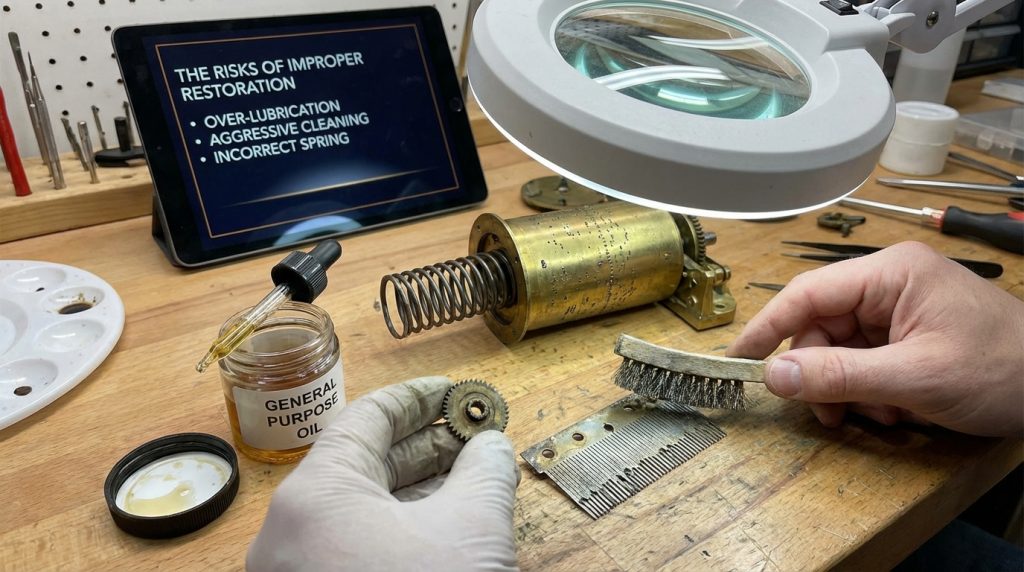
Over-Lubrication and Contamination
One of the most common mistakes in amateur repair is excessive lubrication. While lubrication is essential, too much oil attracts dust and debris, forming an abrasive paste that accelerates wear.
Improper lubrication can result in:
- Increased friction rather than reduced friction
- Sluggish or inconsistent operation
- Accelerated wear on pivots and gears
- Contamination of the comb and cylinder
Historic mechanisms require precise, minimal lubrication using appropriate materials—never general-purpose oils.
Aggressive Cleaning and Polishing
Original surfaces and patina are critical to both historical integrity and value. Over-cleaning or polishing can remove protective finishes, alter tolerances, and erase evidence of original craftsmanship.
Common errors include:
- Polishing gears or combs to a mirror finish
- Using abrasive cleaners or wire brushes
- Stripping original finishes from cases or components
Once original material is removed, it cannot be restored.
Incorrect Spring Replacement
Mainsprings must be matched precisely to an instrument’s original specifications. Installing a spring that is too strong—or incorrectly sized—can overstress the entire mechanism.
Consequences include:
- Bent arbors and gears
- Broken teeth or comb damage
- Increased wear throughout the drive train
- Catastrophic mechanical failure
Incorrect spring replacement is among the most destructive errors in music box repair.
Improper Comb Work and Tuning
Comb repair and tuning are irreversible processes. Improper filing, incorrect pitch reference, or uneven shaping permanently alters sound and destroys authenticity.
Typical mistakes include:
- Over-filing teeth
- Using electronic tuners without musical context
- Attempting tuning without training or experience
A damaged comb often cannot be replaced, making such errors especially costly.
Non-Reversible Modifications
Modern adhesives, welding, or permanently altered components prevent future conservation and compromise historical value. Restoration should always allow for future care and improved techniques.
Non-reversible modifications lock an instrument into a compromised state.
Structural and Case Damage
Cases are often overlooked, yet they play a vital role in alignment and acoustics. Improper repairs—such as forcing mechanisms into warped cases or ignoring structural instability—can introduce new mechanical issues.
Case damage often manifests later as unexplained mechanical problems.
Loss of Historical and Monetary Value
Improper restoration diminishes both historical integrity and collectibility. Collectors, museums, and institutions value originality, documentation, and ethical conservation.
Once compromised, value is difficult—or impossible—to recover.
Why Expertise Matters
Professional restoration protects not only the instrument, but its legacy. Expertise prevents mistakes that permanently silence or distort mechanical music.
Choosing a qualified specialist is not merely a preference—it is a responsibility.
Long-Term Care After Restoration
Protecting Your Music Box for Generations to Come
A properly restored antique music box is a stable, expressive instrument—but it remains a precision mechanical object that requires thoughtful care. Long-term preservation depends not only on expert restoration, but on how the instrument is stored, handled, and maintained afterward. With proper care, a restored music box can continue to perform reliably and retain its historical value for decades.
Environmental Conditions: Climate Matters
Antique music boxes are sensitive to environmental changes, particularly humidity and temperature. Fluctuations can cause metal components to expand or contract and wooden cases to shift, potentially affecting alignment and tuning.
Recommended conditions include:
- Stable temperatures between 60–75°F
- Relative humidity between 40–55%
- Avoidance of direct sunlight or heat sources
- Protection from damp or excessively dry environments
Consistent conditions are more important than perfection.
Proper Handling and Operation
Music boxes are designed to be played, but they must be handled gently. Abrupt winding, forcing controls, or playing damaged instruments can introduce unnecessary strain.
Best practices include:
- Wind slowly and stop when resistance increases
- Do not force start/stop or tune-selection levers
- Allow the mechanism to come to rest naturally
- Avoid overplaying—moderation extends longevity
Regular, gentle use helps keep lubricants distributed and components active.
Storage and Display Considerations
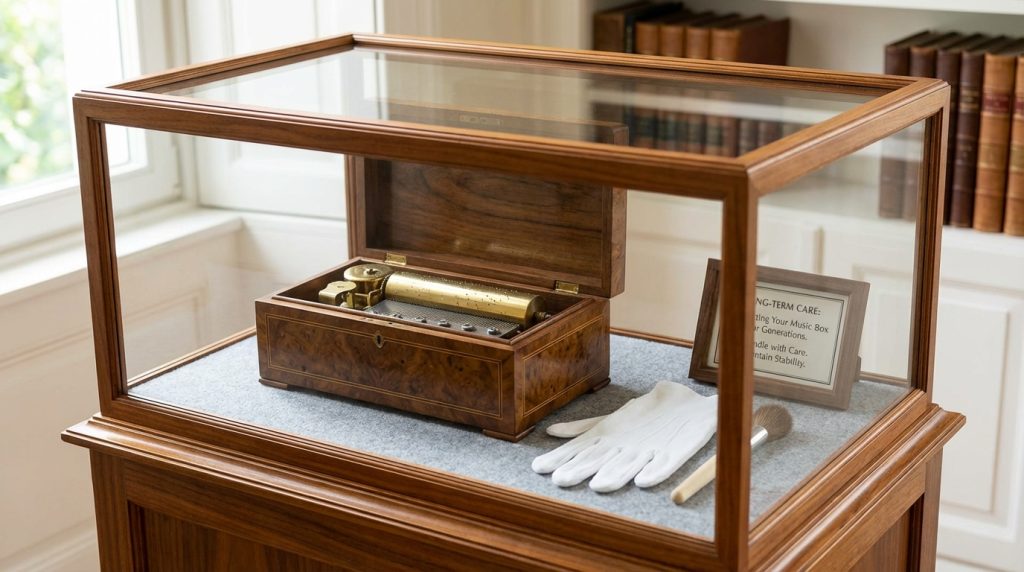
Whether displayed or stored, music boxes should be placed on stable surfaces away from vibration. Display cases should allow for air circulation while protecting from dust.
If stored for extended periods:
- Release spring tension when appropriate
- Cover the instrument to prevent dust accumulation
- Avoid stacking or pressure on the case
Improper storage is a leading cause of preventable damage.
Periodic Professional Maintenance
Even well-maintained music boxes benefit from periodic professional evaluation. Lubricants degrade over time, and subtle wear can develop unnoticed.
A general guideline:
- Professional inspection every 5–10 years
- Earlier evaluation if performance changes are noticed
Preventive maintenance is far less invasive—and costly—than corrective restoration.
Warning Signs That Require Attention
Seek professional evaluation if you notice:
- Changes in tempo or tone
- Mechanical noise or resistance
- Missed or repeated notes
- Visible corrosion or dust accumulation
Early intervention preserves both function and value.
Preserving Documentation and History
Keep records of restoration work, provenance, and historical information with the instrument. Documentation enhances historical value and supports future care.
This information becomes part of the music box’s ongoing story.
Stewardship Through Care
Caring for an antique music box is an act of stewardship. Thoughtful handling and maintenance ensure these instruments continue to sing as living history rather than fall silent through neglect.
Long-term care honors both the craftsmanship of the past and the responsibility of the present.
Preserving Mechanical Music for the Future
Stewardship, Legacy, and the Responsibility of Care
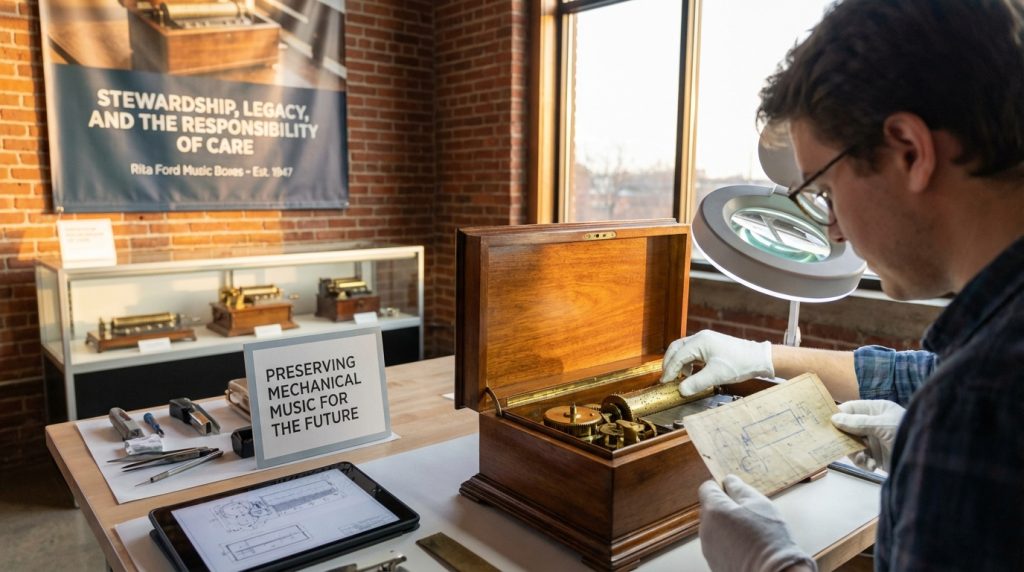
Mechanical music boxes are more than historical objects—they are living instruments that embody the ingenuity, artistry, and musical expression of their time. Each restored music box represents a rare and fragile connection to an era before recorded sound, when music was brought to life through precision engineering and human craftsmanship alone. Preserving these instruments ensures that their voices continue to be heard, not merely remembered.
The future of mechanical music depends on informed stewardship. Without proper care, expert restoration, and respect for originality, these instruments risk becoming silent artifacts rather than living history.
Restoration as Cultural Preservation
Every music box tells a story: of its maker, its owner, the music it carried into homes, and the moments it accompanied. Restoration preserves these stories by maintaining both mechanical function and musical authenticity.
When restored responsibly, a music box remains:
- Historically accurate
- Musically expressive
- Mechanically stable
- Culturally meaningful
This level of preservation transforms restoration from a technical service into a form of cultural conservation.
Passing Sound Through Generations
Unlike many antiques, music boxes are meant to be experienced through sound. Hearing an original instrument play today provides a direct sensory connection to the past—one that no photograph or recording can fully replicate.
Preserving mechanical music ensures:
- Future generations can hear authentic pre-electronic sound
- Musical traditions remain accessible and tangible
- Craftsmanship is appreciated as both art and engineering
Each restored instrument becomes an audible legacy.
The Role of Collectors, Institutions, and Restorers
Preservation is a shared responsibility. Collectors, museums, and restorers each play a vital role in safeguarding mechanical music. Informed ownership, ethical restoration, and proper care ensure these instruments survive intact.
Choosing expertise over convenience protects not only individual instruments, but the broader heritage of mechanical music.
A Continuing Commitment
Since 1947, Rita Ford Music Boxes has been dedicated to the repair, restoration, and sale of antique music boxes, guided by a commitment to authenticity, craftsmanship, and musical integrity. This work is not merely about preserving objects—it is about preserving sound, history, and meaning.
Mechanical music endures when it is respected, understood, and cared for. Through expert restoration and responsible stewardship, these extraordinary instruments continue to sing—bridging centuries through melody.
Begin Your Restoration Journey
If you own an antique music box in need of repair or restoration, professional evaluation is the first step toward preservation. Entrust your instrument to Rita Ford Music Boxes who understands both the mechanics and the music behind it.
